French flag German flag italian flag Mexico flag Spain flag Portugese flag Korean flag Chinese flagJapanese Flag 日本语
France     Germany       Italy    Mexico       Spain         Portugal   Korea      China        Japan                                                                       
Peanut

PeanutAVOID

peanut avoid aflatoxin

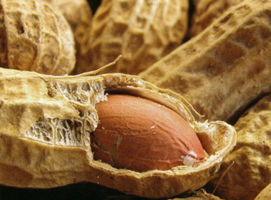
Peanut AVOID even in small quantities. This contains aflatoxin a strong carcinogen. Aflatoxin and Cancer: Cracking a Hard Nut in Developing Countries
   
Groundnuts (peanuts) contain aflatoxin, an invisible, odorless contaminant that is toxic in very tiny doses. Aflatoxin in groundnut was first reported in 1960 with an outbreak of a disease in England in which about 100,000 turkey chicks died within a few months. It was discovered that their groundnut meal was contaminated with aflatoxin. (Right, chickens affected by aflatoxin).
   
Aflatoxins are carcinogenic, mutagenic, teratogenic, and immunosuppressive. In short, they are downright dangerous, to human beings as well as to livestock.
A recent survey carried out in rural regions in India showed that 21% of groundnut samples contained non-permissible aflatoxin levels. Besides being a health risk to consumers, groundnut farmers are badly hit by the loss of export markets, which will not accept contaminated crops.
The problem is complex, because it is influenced not only by the production of the toxin by a fungus in the field or in storage, but also by handling and processing after harvest, where contaminated lots can be unknowingly mixed with clean ones. A solution will require a systems approach - and close coordination among a range of institutions, communities, and governments.
Previous research by ICRISAT and partners such as the Scottish Crops Research Institute, through DFID funding, scored a number of successes, including the development of tools for diagnosing aflatoxins in food cheaply and accurately. Other work enhanced the understanding of the genetics of seed colonization and seed infection by A. flavus, the fungus that leads to aflatoxin contamination; and developed methods for screening plants to identify those which may be resistant to the fungus.
The problem is by no means limited to Asia, either. Africa is grappling with the same complex problems, and needs plenty of help. ICRISAT lent its expertise in a recent inter-institutional workshop in West Africa, aimed at exploring strategies towards solutions. Scientists from countries across the West Africa region, along with US universities involved in the Peanut Collaborative Research Support Program (Peanut CRSP) consortium, Centre de Coopration Internationale en Recherche Agronomique pour le Dveloppement (CIRAD), and ICRISAT participated.


My opinion and the opinion of many individuals trained in holistic medicine, is that peanuts are a food to be avoided by humans. This might be food excellent for squirrels but as far as humans goes, the peanut (even organic, demeter and sugar free brands of ground peanut butter has the potential to be very harmful and create an environment ripe for the development of cancers). The peanut has a fungus that clings to it called peanut fungus aspergillus flavus. This is present even if grown organically or by bio-dynamic methods. I noticed that some individuals who developed liver cancers favored eating peanuts as their personal choice of a nut to eat.

The search for peanuts began when I noticed that eating peanut butter made my liver ache. I delved into it further. I even bought a vita-mixer and ground my own peanuts into peanut butter. Same results were achieved of liver pain.

I now grind my own almond butter and experience no pain and I remain alkaline. I also love cashew butter. If one puts a little tupelo honey in with the ground almonds you can make something called Marizipan candy. This sweet is both alkaline and when made with tupelo honey seems to be beneficial for cystic livers.

pkdiet.com polycystic kidney disease polycystic liver diseasecontact us
last updated: Monday, December 28, 2009 4:41 PM